Home › Shining Force II › The mithril RNG
Shining Force II — The Mithril Weapon RNG
How the dwarf smith really picks your weapon
The short version
The dwarf does not roll once. He rolls up to four times, down a ladder of four weapons chosen by the recipient's class, and stops at the first roll that comes up zero. The four rungs are 1 in 16, 1 in 8, 1 in 4 and certainty, which works out at 6.25 percent for the rarest weapon and 62.39 percent for the common one. The community's long-standing estimate of those odds has the right shape, but the real ladder is steeper than anyone had measured.
The whole thing is decided the instant you hand the mithril over. Collecting the
weapon later is a table lookup, and what you are going to get is already sitting in
work RAM at $FFF7A8 where you can read it. The seed advances one step per
frame while the smith's text box waits for a button, so the frame you press on decides
the weapon — which is what makes this exploitable rather than merely
interesting.
What everybody knows
Somewhere past the middle of Shining Force II there is a hidden village of dwarves on Grans Island, opened with the Dry Stone at a bend in the river north of Galam. In it there is a blacksmith who will take a lump of mithril off your hands, charge you 5000 gold, and turn it into a weapon. Mithril is scarce, the weapons he can make are among the best in the game, and he decides which one you get without asking your opinion.
What is known about him is a mixture of solid work and folklore. The mithril weapons page of Shining Force Central's Ultimate Shining Force 2 Guide gives odds — "about 4%" for the best weapon in a class, "about 48%" for the least powerful, 26 for the second least and 22 for the second best — and a list of which weapon to aim for per class. Alongside that runs the old advice that you can lean on the outcome by walking a certain number of steps between handing the mithril over and coming back for it.
The odds turn out to be a decent estimate of a real thing. The steps turn out to be a proxy for something else entirely. Here is the machinery underneath both.
The generator
Shining Force II carries two random number generators, each with a wrapper in front
of it. The one that matters for mithril lives at ROM $001600. It is a sixteen-bit linear congruential
generator whose entire state is one word of work RAM at $FFDEA4.
001600  move.w  ($FFDEA4).l,d7    ; the current seed
001606  mulu.w  #13,d7
00160A  addi.w  #7,d7
00160E  andi.l  #$FFFF,d7
001614  move.w  d7,($FFDEA4).l    ; the seed advances BEFORE it is used
00161A  move.w  d6,-(sp)
00161C  add.w   d6,d6             ; d6 = 2 * range
00161E  mulu.w  d6,d7             ; 32-bit product
001620  swap    d7                ; keep the high word
001622  move.w  (sp)+,d6
001624  lsr.w   #1,d7             ; result: 0 .. range-1
001626  rts
In arithmetic, with the seed called s and the caller's range in
d6:
s      ←  (13 * s + 7)  mod 65536
value  =  floor( s * range / 65536 )
Three properties of it decide everything that follows, and all three can be checked by exhaustion rather than taken on faith.
Its period is exactly 65536. It walks through every single sixteen-bit value before it repeats, which it has to: the Hull-Dobell conditions hold, because 7 is odd and therefore coprime with 65536, and 13 minus 1 is 12, which is divisible by 4. There is no short cycle to fall into and no seed that traps you.
Its output is uniform. Over one full cycle, with a range of 4 or 16 or 32, every result comes up exactly the same number of times, and with a range of 100 the most and least common differ by one. Nothing is structurally unlucky.
And the result is a pure function of the seed. Not of the clock, not of the character, not of how many mithril you have handed over before. Know the seed and you know the answer. That single fact is the hook the rest of this article hangs on.
None of which is a discovery. The Shining Force II speedrunning community had this
generator years ago — you will find it quoted on
GameFAQs as
R2 = remainder((R1 * 13 + 7) / 65536), together with the observation that it
travels through all 65536 values. The listing above is that formula read straight off the
instructions.
Where the weapon is chosen
The routine is at ROM $021EDA. It is ordinary 68000 code, not a script
command, which is why searching the ROM for the item ID of a mithril weapon never turns
it up — the IDs live in a packed data table, not as immediate operands.
It runs in two halves. The first looks up the recipient's class and turns it into a group number. The second walks four entries of that group and stops at the first roll that returns zero.
021EDA  clr.w   d0
021EDC  lea     $21F62(pc),a0     ; class -> group table
021EE0  move.w  #7,d7             ; eight groups
021EE4  move.w  (a0)+,d6          ; how many classes in this group
021EE6  subq.w  #1,d6
021EE8  move.w  (a0)+,d1
021EEA  move.w  -$18(a6),d2       ; the recipient's class
021EEE  cmp.w   d1,d2
021EF0  beq.w   $21F16            ; found it, d0 = group index
021EF4  dbra    d6,$21EE8
021EF8  addi.w  #1,d0
021EFC  dbra    d7,$21EE4
021F00  clr.w   d0                ; class not listed anywhere:
021F02  move.w  #2,d6
021F06  jsr     $1600.w           ;   flip a coin
021F0A  cmpi.w  #0,d7
021F0E  bne.w   $21F16            ;   1 -> group 0 (swords)
021F12  move.w  #2,d0             ;   0 -> group 2 (axes)
021F16  lsl.w   #3,d0             ; eight bytes per group
021F18  lea     $21F92(pc),a0     ; weapon table
021F1C  adda.w  d0,a0
021F1E  move.w  #3,d5             ; four attempts, and no more
021F22  clr.w   d0
021F24  clr.w   d1
021F26  move.b  (a0)+,d0          ; probability parameter
021F28  move.b  (a0)+,d1          ; item ID
021F2A  move.w  d0,d6
021F2C  jsr     $1600.w           ; the roll
021F30  cmpi.w  #0,d7
021F34  beq.w   $21F3C            ; zero -> you get this one
021F38  dbra    d5,$21F22         ; otherwise try the next entry
021F3C  lea     $F7A8.w,a0        ; queue of weapons being forged
021F40  move.w  #3,d7
021F44  cmpi.w  #0,(a0)
021F48  bne.w   $21F52
021F4C  move.w  d1,(a0)           ; park the item ID here
021F4E  bra.w   $21F5C
021F52  move.w  #2,d0
021F56  adda.w  d0,a0
021F58  dbra    d7,$21F44
021F5C  movem.l (sp)+,d0-d7/a0
021F60  rts
The last entry of every group carries the probability parameter 1, and
Random(1) can only ever return 0. So the fourth rung is not a roll at all
— it is the floor. You always walk out with something.
Step one: your class picks the shortlist
The table at $021F62 is a list of eight groups. Each starts with a count
and is followed by that many class IDs. It comes to thirteen classes across the eight
groups and ends at $021F8C. The four-letter labels are the game's own,
lifted from the class name table at $017F3E, so the fastest way to find a
character's group is to open their status page and read the class field.
| Group | Classes | 6.25% | 11.54% | 19.82% | 62.39% |
|---|---|---|---|---|---|
| 0 | HERO, BDBT | Levanter | Counter Sword | Battle Sword | Critical Sword |
| 1 | PLDN, PGNT | Holy Lance | Halberd | Mist Javelin | Valkyrie |
| 2 | GLDT | Rune Axe | Ground Axe | Atlas Axe | Heat Axe |
| 3 | WIZ, SORC | Mystery Staff | Freeze Staff | Great Rod | Supply Staff |
| 4 | VICR | Mystery Staff | Goddess Staff | Great Rod | Holy Staff |
| 5 | SNIP, BRGN, BWNT | Grand Cannon | Grand Cannon | Hyper Cannon | Buster Shot |
| 6 | NINJ | Gisarme | Ninja Katana | Katana | Critical Sword |
| 7 | MMNK | Giant Knuckles | Giant Knuckles | Misty Knuckles | Misty Knuckles |
Two of those rows are not what they look like. Group 5 lists the Grand Cannon twice, so a Sniper, a Brass Gunner or a Bow Knight gets it on either of the first two rungs — 17.79 percent rather than 6.25. Group 7 has only two distinct weapons in four slots, so a Master Monk has no four-step ladder at all: Giant Knuckles 17.79 percent, Misty Knuckles 82.21 percent, and nothing else is possible.
Then there is the branch nobody talks about. Thirteen classes are listed. Every other
class in the game falls through the whole loop to $021F00 and gets a coin
flip between group 0 and group 2 — the Hero's swords or the Gladiator's axes. That
covers every unpromoted character, and among the promoted classes it covers BRN, WFBR,
PHNX and RDBN. Hand your mithril to one of those and the smith rolls on a list that was
built for somebody else.
This is also where the ROM disagrees with the community list. Shining Force Central's guide files BRN and RDBN alongside GLDT as classes that get the Rune Axe. They can get it, but not the same way: only GLDT is in the table. BRN and RDBN reach the axe group through the coin flip, which means half the time they are rolling on the Hero's sword list instead.
Step two: four rolls down a ladder
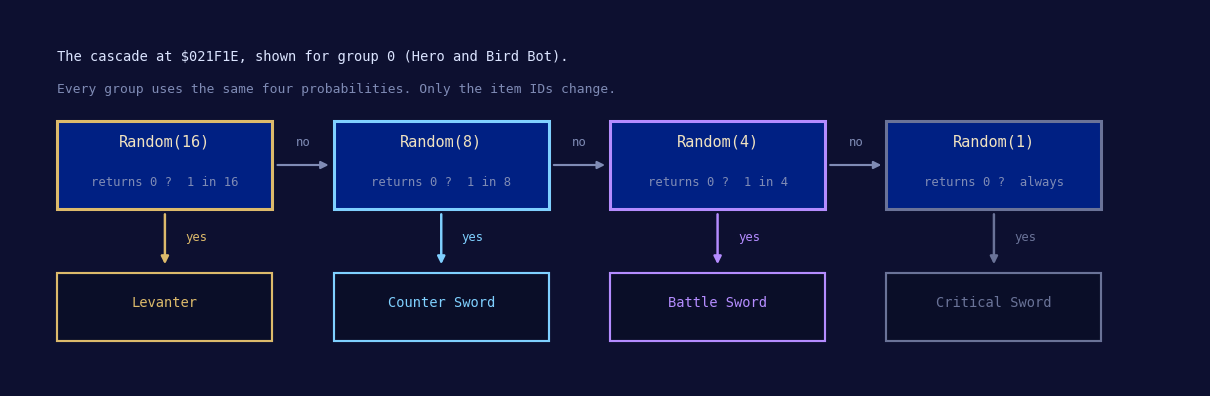
The weapon table at $021F92 is eight bytes per group, four pairs of
(probability, item ID). Here it is verbatim:
021F92  10 45  08 44  04 42  01 41   group 0
021F9A  10 51  08 53  04 52  01 50   group 1
021FA2  10 2B  08 2A  04 29  01 28   group 2
021FAA  10 64  08 62  04 5F  01 60   group 3
021FB2  10 64  08 63  04 5F  01 61   group 4
021FBA  10 36  08 36  04 35  01 34   group 5
021FC2  10 6D  08 6C  04 6B  01 41   group 6
021FCA  10 1F  08 1F  04 1E  01 1E   group 7
           ^^ ^^
           |  the item ID, indexing the table at $01788D
           the argument handed to Random()
The regularity is the giveaway. 10 08 04 01 in every single row. Whoever
wrote this wanted one dial per group and turned it the same way eight times.
The odds, exactly
Multiply the rungs out and you get 6.25, then 11.72, then 20.51, then 61.52 percent. But those are the numbers you would get from four independent coin flips, and these rolls are not independent — they come from consecutive steps of the same generator, which correlates them slightly. So rather than trust the arithmetic I walked all 65536 possible seeds through the routine and counted.
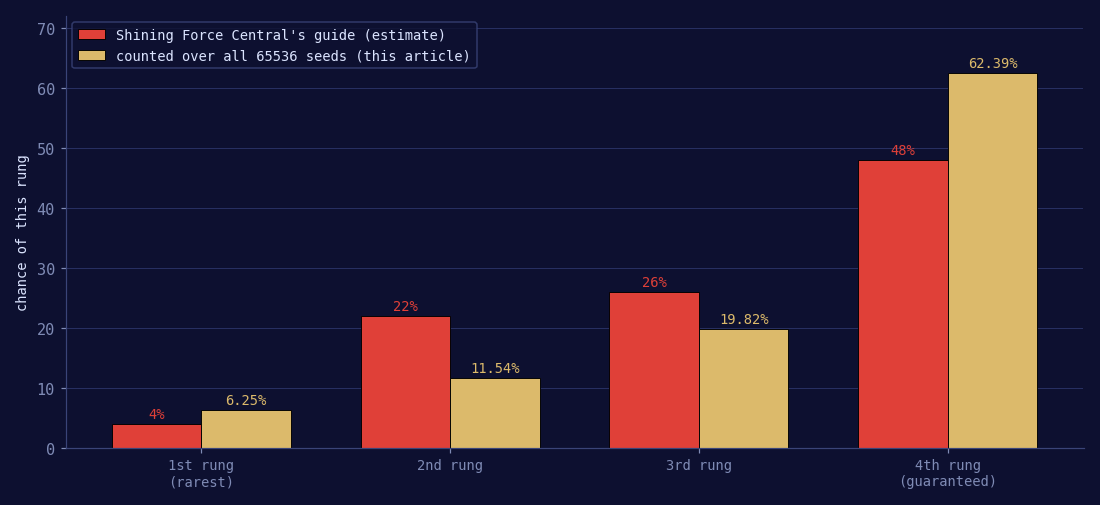
- 1st rung
- 6.2500 percent, the rarest
- 2nd rung
- 11.5387 percent
- 3rd rung
- 19.8227 percent
- 4th rung
- 62.3886 percent, and it can never fail
Set that against the guide's estimate. The shape is right, and whoever arrived at those numbers was measuring something real — the ladder does run in that direction, and the rare weapon really is the rare one. But the ROM is steeper. The guaranteed rung is 62.39 rather than 48, both middle rungs are smaller than the guide has them, and the rarest is 6.25 rather than 4. Counting mithril by hand gets you the shape. It will not get you the third decimal, and it will not tell you where the numbers come from.
What that steepness means in practice: if you have ever handed over four mithril and walked away with four Critical Swords, nothing was wrong with your luck. The chance of getting no first-rung weapon at all out of four mithril is a little over 77 percent.
One caution about the word best. The ladder is ordered by rarity, and for most groups the rarest weapon is also the one people want — Levanter for a Hero, Rune Axe for a Gladiator, Grand Cannon for a Sniper, and SFC's per-class list agrees with the ROM on all of those. Group 1 is the exception worth knowing about. The ROM makes the Holy Lance the rarest thing a Paladin or Pegasus Knight can be handed, while the guide points that class at the Mist Javelin, which sits on the third rung. Rarity and usefulness are two different questions and this article only answers the first.
The weapon is already in memory before you collect it
The tail of the routine, from $021F3C, walks a queue of four words at
$FFF7A8 and drops the item ID into the first empty slot.
That is the smith's work order, and it is written the moment you hand the mithril over.
The lottery is over before he finishes his sentence. Coming back later, walking a lap of
the village, saving and reloading in between — none of it can change anything,
because there is nothing left to decide.
Which also makes the whole thing falsifiable, and that is the useful part. I ran the
ROM with the calls at $001600 instrumented, on a savestate taken the instant
after the mithril changed hands. The log came back with exactly four entries, all from
the call site at $021F2C:
seed $44BE   Random(16) -> 7    miss
seed $7DAD   Random( 8) -> 3    miss
seed $61D0   Random( 4) -> 3    miss
seed $F797   Random( 1) -> 0    hit
Each seed is the previous one advanced by one step, so the chain is intact. Three
misses and then the floor. Four rolls and no coin flip means the class was one of the
thirteen in the table, and the word at $FFF7A8 in that savestate reads
$001E, which is Misty Knuckles — the fourth entry of group 7, and the
only group it can be. So the recipient was a Master Monk. Predicted from the ROM,
confirmed in RAM, and confirmed again when the player collected the weapon.
Two more savestates line up the same way. One taken before speaking to the smith
holds $0042, a Battle Sword already on order. One taken after collection
holds $0000, the queue empty again.
Why walking a set number of steps seems to work
Because of what the seed does while you are reading. At ROM $006470 is
the loop that waits for you to press a button to advance a text box:
006470  moveq   #$14,d2
006472  movem.l d6-d7,-(sp)      <-- top of the loop
006476  move.w  #$100,d6
00647A  bsr.w   $1600            ; the seed advances HERE, once per frame
00647E  move.b  d7,($DFB0).w     ; and reseeds the second generator
006482  movem.l (sp)+,d6-d7
006486  bsr.b   $64A8
006488  bsr.w   $0EEE            ; wait for vblank
00648C  move.b  ($DE9B).w,d1     ; read the pad
006490  andi.b  #$7F,d1
006494  beq.b   $6472            <-- nothing pressed, go round again
One trip round that loop is one frame and one advance of the seed. Every frame a text box sits on screen waiting for you, the generator moves.
Walking barely touches it. I measured that directly, by loading a savestate in a
headless emulator, holding a direction and reading $FFDEA4 at known frames:
the seed advanced 2 steps over 60 frames of walking and 3 more over the next 80. That is
one step every 28 frames, against one step every single frame inside a text box.
Which explains the folklore. Steps never mattered on their own. What mattered was that walking a different route changed when you arrived at the smith's dialogue and how many frames of text went past before the roll. The step count was a clumsy proxy for a frame count, and that is why the trick works for the person who discovers it and falls apart for everyone who copies it. The speedrunners reached the frame count before me. What the ROM adds is the rate.
How to get the best mithril weapon every time
The result is a pure function of the seed, and the seed advances one step per frame while the smith's text box waits for you. Therefore the frame on which you press the button decides which weapon you get, and pressing one frame later gives a different, entirely repeatable result. That turns save-scumming from a gamble into arithmetic.
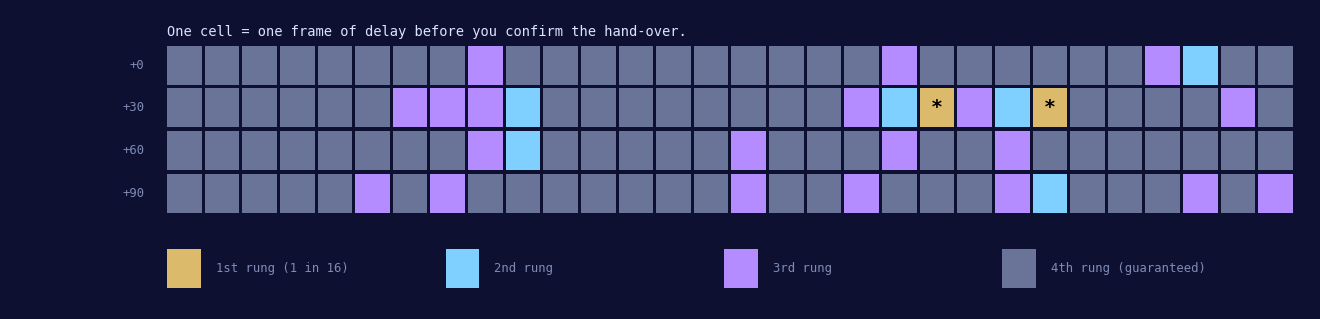
You want an emulator with savestates and a RAM watch. BlastEm, Exodus, Gens KMod and Regen all qualify.
- Go through the dialogue until you are one button press away from the smith taking the mithril. That press is the one that runs the routine. Save a state right there.
- Press. As soon as he tells you to come back later, read the word at
$FFF7A8in the RAM watch. That is your weapon, and you have not walked a single step yet. - If it is not the one you wanted, load the state and press one frame later. One frame of delay is one step of the seed, so the outcome changes, and it changes the same way every time you repeat it.
- Repeat until
$FFF7A8holds the ID you want, then walk away and collect it. Nothing after this point can change the result.
How long that takes has a hard answer. Walking the generator's entire orbit and measuring the gaps between first-rung seeds: the average wait is 15 frames and the worst case anywhere on the orbit is 114 frames. There is no seed from which the first rung is unreachable, and no run of bad luck longer than about two seconds of held breath.
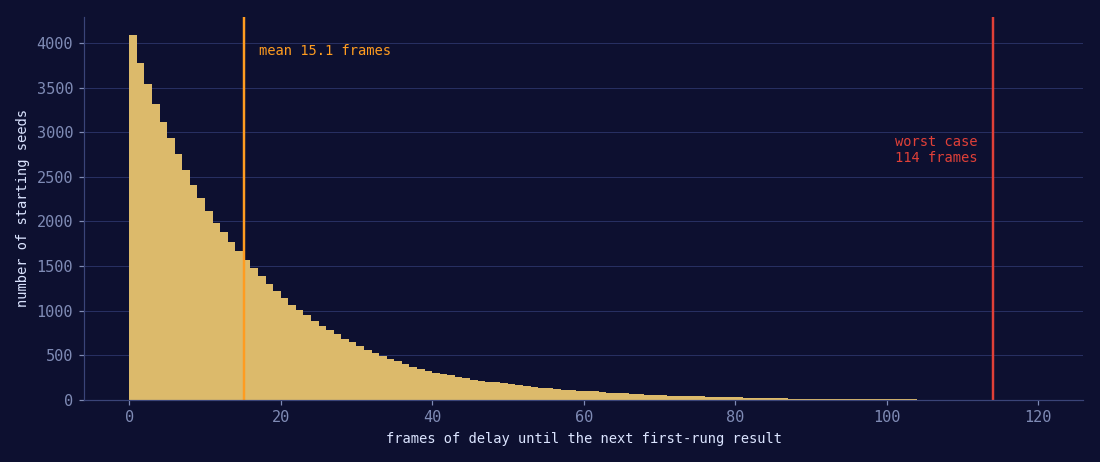
If you would rather compute than reload, put the watch on $FFDEA4
instead, note the value while the text box is open, and let the script work out how many
frames to wait. It carries both ROM tables, reimplements the generator instruction by
instruction, prints the exhaustive odds for any group with --odds, and needs
nothing but Python 3.
$ python3 sf2-mithril.py 0x44BE MMNK

seed $44BE   class MMNK   group 7

  what happens right now
    seed $44BE  Random(16) -> 7   Giant Knuckles
    seed $7DAD  Random( 8) -> 3   Giant Knuckles
    seed $61D0  Random( 4) -> 3   Misty Knuckles
    seed $F797  Random( 1) -> 0   Misty Knuckles   <-- taken
    result: Misty Knuckles

  wait 27 frame(s) longer before confirming to get Giant Knuckles.
One thing to settle before you touch the frame counter: pick the recipient deliberately, because the class fixes the shortlist before any roll happens. Handing mithril to a Master Monk caps you at Giant Knuckles however perfect your timing is, and handing it to an unpromoted character throws away half the outcome on a coin flip between swords and axes. Promote first, then hand over.
On original hardware none of this is available. You cannot count frames by eye and
you cannot read $FFF7A8. Blind save-scumming still works, but it is blind,
and at 6.25 percent it will take a while.
The debug hook they left in
The second generator is unremarkable — it sits at $001652 with its
seed at $FFDFB0, runs seed = seed * 541 + 12345, and is wrapped
at $001628 with rejection sampling to clean up ranges that are not powers of
two. The other wrapper, the one at $001674 that sits in front of the mithril
generator, is the interesting one:
001674  movem.l d6-d7,-(sp)
001678  move.w  d0,d6
00167A  tst.b   ($FFB0A9).l       ; debug flag
001680  beq.b   $16B2             ; zero -> fall through to the real generator
001682  moveq   #0,d0
001684  btst.b  #3,($DE97).w      ; a direction on the pad -> return 0
00168A  bne.w   $16B8
00168E  moveq   #1,d0
001690  btst.b  #0,($DE97).w      ;                       -> return 1
001696  bne.w   $16B8
00169A  moveq   #2,d0
00169C  btst.b  #2,($DE97).w      ;                       -> return 2
0016A2  bne.w   $16B8
0016A6  moveq   #3,d0
0016A8  btst.b  #1,($DE97).w      ;                       -> return 3
0016AE  bne.w   $16B8
0016B2  bsr.w   $1600             ; nothing held, or flag clear: roll for real
0016B6  move.w  d7,d0
0016B8  movem.l (sp)+,d6-d7
0016BC  rts
Set $FFB0A9 to anything but zero and the random numbers stop being
random: four directions on the D-pad map to four fixed values from 0 to 3. All 26 calls
to this wrapper sit between $009FC0 and $00C2B8, which is
battle code — criticals, double attacks, damage variance. Somebody at Sonic!
Software Planning could hold a direction and choose the outcome of every roll in a fight.
It is not the road to mithril, but it is worth knowing it is still in the cartridge.
What was already known
Not much of the groundwork here is mine, and it is worth being clear about which part is. The formula, the full period, the frame count instead of the step count, a usable estimate of the odds and a per-class list of what to aim for were all in circulation before I started, on GameFAQs and on Shining Force Central's mithril weapons page. That per-class list agrees with the ROM everywhere except the two cases above.
What this article adds is the routine itself at $021EDA, the two data
tables behind it, exact probabilities in place of an estimate, the coin-flip branch for
classes that are not in the table, and the queue at $FFF7A8 that lets you
read the answer the moment it is decided.
How this was done
The subject is Shining Force II (USA), 2 097 152 bytes,
MD5 6473b1505334ef5620d13191c18251fe. Every address quoted above is an
offset into that file. It was disassembled with Capstone in Motorola 68000 mode and read
by hand, which found the generator quickly and the choice routine slowly — the
useful search is not for item IDs but for the shape of a table, a run of bytes
alternating small powers of two with values in the item-ID range. Once
10 xx 08 xx 04 xx 01 xx turned up eight times in a row at
$021F92, the rest fell out.
Confirming it needed live data. The ROM was patched so that every call to
$001600 wrote its return address, its range argument and the seed before and
after into a ring buffer in unused work RAM. Gens savestates were converted into Genesis
Plus GX savestates so a headless build of the core could run them, which is where the
four logged rolls and the walking measurement came from. The probabilities and the wait
times were computed by brute force over the full 65536-seed space rather than sampled.
Everything here is reproducible with a copy of the ROM, Python, and any emulator with a RAM watch. If you check it and something does not match, please say so.
Questions people actually ask
What are the real odds of the best mithril weapon in Shining Force 2?
The four rungs come out at 6.2500, 11.5387, 19.8227 and 62.3886 percent, counted over every possible seed. Shining Force Central's guide estimates about 4 percent for the best weapon and about 48 for the least powerful, which is the right shape but a flatter ladder than the ROM actually has.
Does walking a set number of steps work?
No. The weapon is decided when you hand the mithril over, so anything you do afterwards is too late, and the speedrunning community had already established that the real lever is frames rather than steps. The seed advances once per frame while a text box waits for a button, and only about once every 28 frames while you walk.
Can I see what I am getting before I collect it?
Yes. Read the word at $FFF7A8 in a RAM watch as soon as you have handed
the mithril over. It is the item ID of the weapon being forged, and there are four
slots in case you have more than one on order.
Does it matter who receives the weapon?
Enormously. The class picks the group before any roll happens. Master Monk can only ever produce Giant Knuckles or Misty Knuckles, Sniper and Brass Gunner and Bow Knight get the Grand Cannon on two rungs instead of one, and any class outside the table — every unpromoted character, plus BRN, WFBR, PHNX and RDBN — gets a coin flip between the Hero swords and the Gladiator axes.
Can I guarantee the rarest weapon?
In an emulator, yes. Save a state on the frame before you press, press, read
$FFF7A8, then reload and press one frame later if it is wrong. The first
rung is never more than 114 frames of delay away and is 15 away on average. On original
hardware there is no way to count frames, so no.
Written August 2026. The first Shining Force has no mithril smith, but it has a room of its own here with a romhack in it. No ROMs are hosted on this site.